
The programmatic trap: Why most publishers are leaving their best revenue on the table
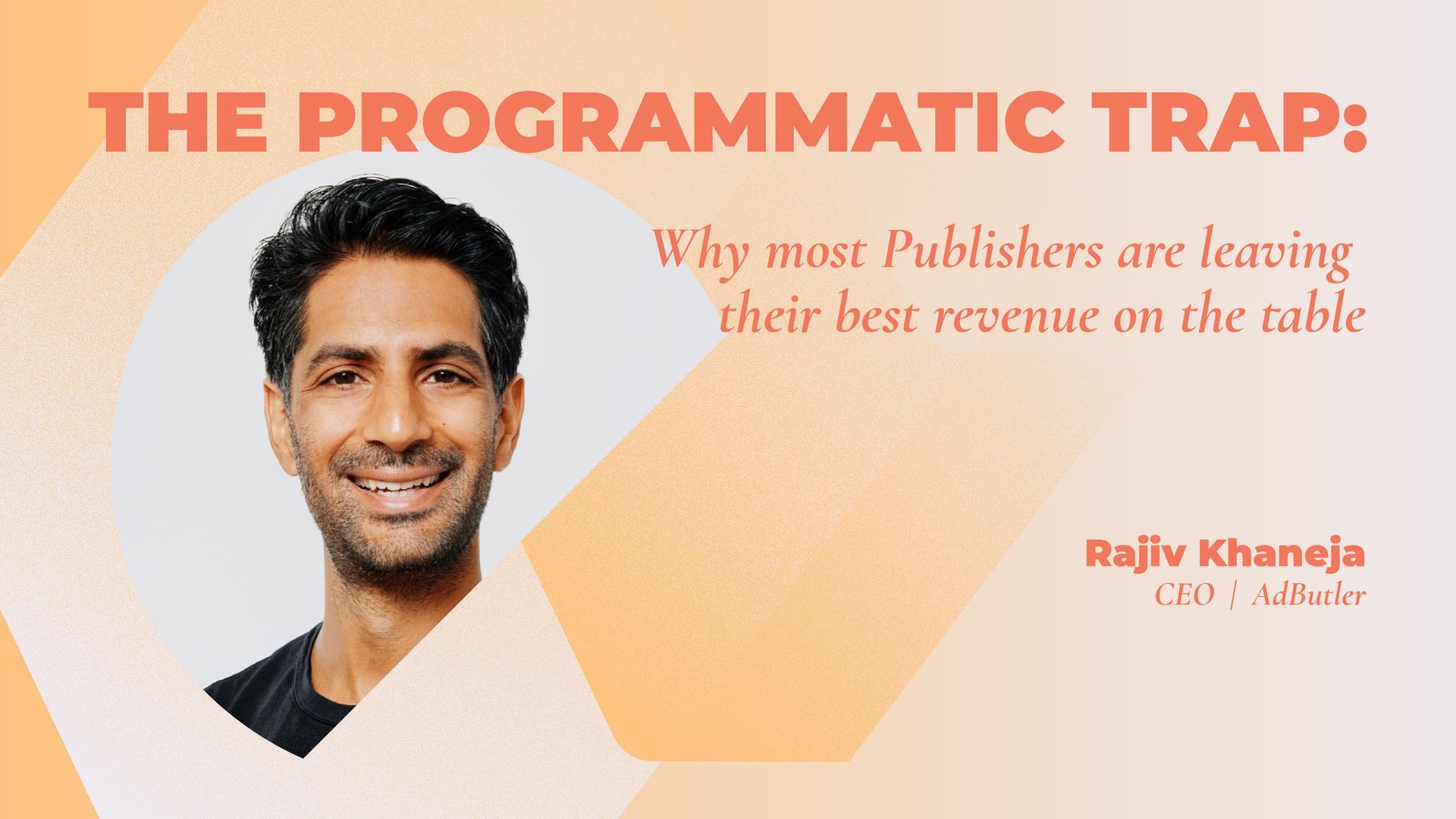
Rajiv Khaneja has watched programmatic advertising go from a radical idea to the default setting for almost every publisher on the internet. In that time, he's identified a problem that's leaving revenue on the table. The good news is, it's entirely solvable.
I have been building ad technology since 1999. In that time, I have watched programmatic advertising go from a radical idea to the default setting for almost every publisher on the internet. That shift created real value. It also created a habit that is quietly costing publishers a significant portion of the revenue they have already earned the right to capture.
The habit is this: businesses are defaulting to programmatic for every impression, including the ones a direct buyer would have paid a premium to own.
I see this pattern constantly across the industry. A publisher runs a clean programmatic setup, revenue is stable, and the team is stretched thin. Direct deals feel complicated, so they stay on the to-do list. Meanwhile, programmatic quietly absorbs inventory that a brand advertiser, a retail media partner, or a sponsorship buyer would have valued at two or three times the open-market rate.
This is not a technology problem. It is an orchestration problem. And it is entirely solvable.
The Misconception That Holds Publishers Back
The most common thing I hear from publishers who have not yet built a hybrid model is some version of this: “If we prioritize direct deals, we will disrupt programmatic and lose revenue during the transition.”
That fear is understandable. It is also based on a false premise.
Direct and programmatic are not competing channels. They are complementary layers in a monetization stack. Programmatic is your liquidity engine: it fills impressions efficiently and ensures no inventory goes dark. Direct deals are your margin layer: they capture premium value from buyers who want guaranteed access to specific audiences and placements. The only scenario where they conflict is one where your ad server has not been configured to keep them in their proper lanes.
Where the Breakdown Actually Happens
In over 25 years of working with publishers, I have seen hybrid monetization break in the same four places every time.
Priority logic is undefined or inconsistent. Teams add direct campaigns to their ad server without establishing clear priority rules. Programmatic, which is always live and always bidding, outserves placements that were supposed to go to a premium buyer. The direct campaign underdelivers. The client is unhappy. The team concludes that direct deals are “complicated” and deprioritizes them. In reality, the technology was never given the right instructions.
Pacing is an afterthought. Direct campaigns have run dates and delivery commitments. Without proper pacing controls, they either burn through impressions too quickly in the first few days or fall short at the end of the campaign. Either way, the result is a makegoods conversation, which is a revenue and relationship cost that compounds over time.
Reporting is fragmented. When direct deals and programmatic run through separate systems, reconciliation becomes a manual job. Teams spend time resolving discrepancies between platforms instead of optimizing revenue. Over time, the operational burden becomes the justification for not scaling direct.
Programmatic becomes the path of least resistance. This is the most insidious failure mode because it does not feel like failure. Revenue is coming in. The system is technically working. But the publisher is training their entire monetization stack to optimize for ease of operation rather than revenue maximization. Every month that continues, the gap between actual and potential revenue widens.
What the Right Setup Looks Like
Publishers who run hybrid monetization well do not treat direct and programmatic as separate problems. They treat the entire stack as a single, coordinated system with clear rules about who gets what.
The model is straightforward in principle:
Direct deals get priority. Guaranteed campaigns, sponsorships, and premium placements are configured to serve first. The ad server enforces this without manual intervention.
Programmatic fills the gaps. Every impression that direct demand does not claim goes to programmatic. No inventory goes unsold. Baseline revenue is protected.
A single control layer manages both. One ad server with unified reporting, pacing controls, and priority logic across all demand sources. No reconciliation work. No competing systems.
What makes this hard to execute is not the concept. It is the configuration. Priority rules need to be defined correctly from the start. Pacing parameters need to reflect actual campaign commitments. The fallback logic needs to be tested before it is live. When those three things are in place, the system runs itself.
The Pattern I See in Publishers Who Get This Right
The publishers who successfully scale hybrid monetization share a few characteristics that have nothing to do with their size or category.
They treat the ad server as a strategic asset, not infrastructure. Most publishers configure their ad server once and leave it alone. High-performing teams revisit priority logic regularly, especially as their direct sales motion evolves. They understand that the rules governing delivery are as important as the demand itself.
They do not launch direct deals at scale before the fallback is confirmed. The mistake I see repeatedly is a publisher signing a significant direct deal, spinning it up in the ad server, and only discovering that the fallback logic is broken when delivery reports come in short. The safe approach is to test the entire chain with a small campaign first: direct priority on, programmatic fallback on, pacing confirmed, reporting unified. Then scale.
They measure blended yield, not channel performance in isolation. A publisher who only tracks programmatic eCPM will systematically undervalue direct deals because the comparison is apples to oranges. Blended yield across all demand sources gives a true picture of whether the orchestration is working.
Why This Matters More in the Current Environment
The economics of open-market programmatic are not improving. Signal loss from privacy changes, ID deprecation, and increased auction competition are compressing CPMs in most categories. Publishers who are entirely dependent on programmatic are running on a treadmill that is gradually slowing down.
At the same time, brands are investing more in direct publisher relationships, retail media networks are pulling budgets away from open exchanges, and first-party data is becoming the primary currency for premium deals. These shifts favor publishers who have built the infrastructure to transact directly.
The publishers who will be in the strongest position three years from now are not necessarily the ones with the largest audiences. They are the ones who built a monetization system that can capture premium value when it is available and fill efficiently when it is not.
The Takeaway
Running direct deals alongside programmatic is not a question of whether to do it. For most publishers with any significant direct sales motion, it is already the right answer. The question is whether your ad server setup allows both channels to perform at their ceiling or whether one is silently undermining the other.
The revenue difference between a well-orchestrated hybrid setup and a purely programmatic default is not marginal. In the thousands of publisher configurations I have seen over the years, it is consistently significant. Not because direct deals are magic, but because premium demand deserves to transact at premium prices, and that only happens when your system is built to let it.
Getting this right is not about adding more demand sources. It is about giving the demand you already have the structure it needs to perform.

Rajiv Khaneja
Investor, entrepreneur and founder of AdButler
Rajiv Khaneja is an investor, entrepreneur, and founder with ventures spanning adtech, biotech, and investment. He is the founder of AdButler, an enterprise adtech platform, Arvita Therapeutics, a cancer vaccine company, and DoubleBlind, an investment holding company.
Founded in 1999 and headquartered in Victoria, British Columbia, Canada, AdButler is a profitable, independent ad serving platform with over 25 years of ad tech mastery, trusted by more than 1,200 clients worldwide to deliver billions of ad impressions monthly. The company provides enterprise-grade ad management solutions that prioritize customer control, data transparency, and superior performance. AdButler's global cloud infrastructure spans over 100 servers worldwide, ensuring reliable, high-speed ad delivery with 100% uptime since 2017, and the company is SOC2 Type 2 certified, carbon neutral, and maintains active membership in the IAB Tech Lab.