
More tools won't fix your data problem
The adtech industry has a stack addiction, says Juan Baron, Head of International and Global Accounts at Decentriq. And like most addictions, it feels like the only answer right up until it isn't.
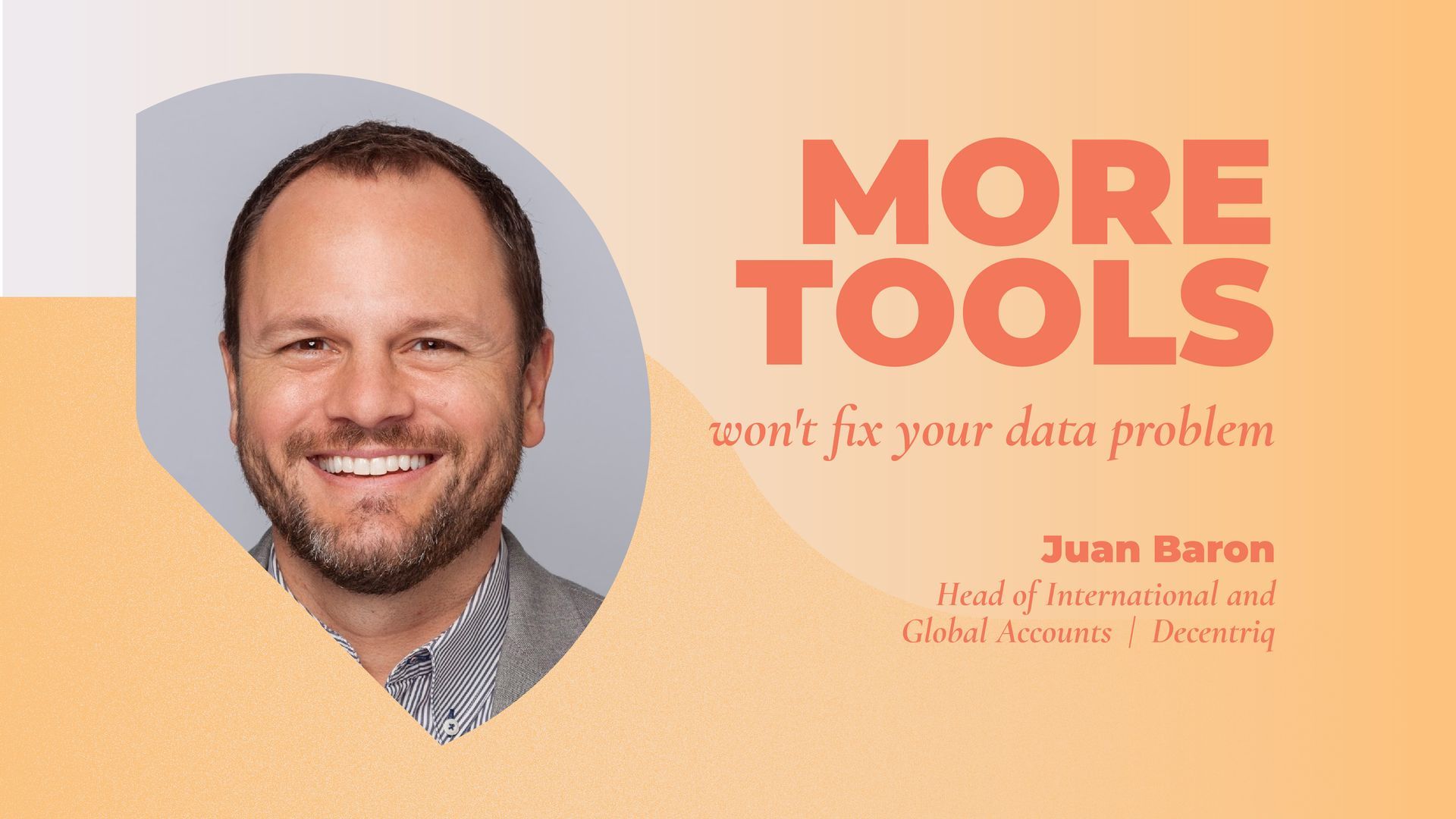
The adtech industry has a stack addiction. And like most addictions, it feels like the only answer right up until it isn't.
Over the past decade, organizations have layered data management platforms upon customer data platforms upon data clean rooms, each addition promising to finally solve the fragmentation problem. The global CDP market alone is projected to reach $28 billion by 2028. Clean rooms for advertising hit $1.4 billion in 2024 and are forecast to grow at 22% annually through 2033. Investment is clearly not the issue.
Yet despite this spending, the fundamental problem persists. According to Gartner, 67% of marketers have adopted a CDP, but on average use less than half of its available capabilities, a figure that has declined year-on-year. Meanwhile, 34% report their data remains siloed across tools and business units. The tools are there. The value is not.
The fragmentation trap
The instinct to add technology when something isn't working is understandable. When audience targeting degrades, buy a DMP. When first-party data becomes the priority, add a CDP. When partners need to share data securely, deploy a clean room. Each decision is rational in isolation. Collectively, they compound the problem. Or in the majority of the cases, switching costs and unwillingness to “rip off the bandaid” prevents organizations from reconsidering their data stack.
This is because what organisations then end up with is a stack of singular solutions that were never designed to work together. different environments, different teams, different schemas, different access controls. The promise of a unified view recedes further with every tool added.
Privacy regulation is forcing the issue
GDPR fines across Europe have surpassed €5.6 billion across more than 2,200 cases. In the US, at least 20 states have enacted comprehensive consumer privacy laws. Third-party cookies (long the connective tissue of cross-platform targeting) are on borrowed time. The infrastructure the industry built its measurement practices on is being dismantled.
This has triggered a real pivot. Reliance on third-party data fell from 75% to 61% of marketers in just two years. First-party data is now the center of gravity. But it only becomes a competitive advantage when it can be activated – and activation increasingly requires collaboration across organisations that cannot, and should not, hand their raw data to each other.
The real unlock: Collaboration as a starting point, not an afterthought
Many organizations assume they have this covered. Their CDP or DMP vendor has added clean room features as an afterthought. Years of building data clean room infrastructure from the ground up has shown that zip-tying siloed data systems without a persistent and fluid user experience, consistent privacy, and security architecture will not pass muster across large enterprises. Not to mention the lack of a persistent ecosystem of partners open for collaboration. Instead, every new collaboration still starts from scratch.
The more effective approach is to build from a collaborative basis from the outset, where DMP, CDP, and clean room capabilities sit within a single environment designed for collaboration from day one, rather than bolted together retrospectively. Decentriq's Collaborative Audience Platform (CAP) is built on this premise.
But the real power is network-driven. The more partners, publishers, retailers, and data owners that participate in a shared collaborative ecosystem, the richer the signal available to everyone. Not because data is pooled, but because each participant retains full ownership and control of their own. Insights are surfaced through individual clean room collaborations, each powered by confidential computing, so the value compounds across the ecosystem without any raw data ever leaving its owner's hands.
Stop buying the problem
The adtech industry has been extraordinarily good at building tools. It has been less good at building the operating models that make those tools work together. As privacy regulation tightens and legacy data infrastructure erodes, that gap is becoming expensive.
The question worth asking isn't "which tool are we missing?" It's "why can't the tools we have collaborate effectively?" Answer that, and the path to meaningful data value becomes considerably clearer.

Juan Baron
Head of International and Global Accounts at Decentriq
Juan Baron is Head of International and Global Accounts at Decentriq. Originally from Colombia, Juan brings a diverse background spanning AdTech in the United States and Europe, with deep expertise in privacy-first advertising and data collaboration. With years of experience on both the AdTech and publisher sides of the industry, Juan has been at the forefront of the shift away from third-party cookies toward first-party data strategies. At Decentriq, he helps brands, publishers, and agencies unlock the value of their data through secure, privacy-compliant collaboration powered by confidential computing technology that guarantees data is never exposed, even to the platform provider.
Decentriq is a clean-room-native data collaboration platform primarily serving the media and advertising industry. Built on secure, privacy-first infrastructure, Decentriq enables publishers, retailers, and advertisers to collaborate on sensitive data without exposure to power audience enrichment, optimize measurement, and uncover valuable insights.
Alongside its data clean room, Decentriq offers the Collaborative Audience Platform: a unified layer that adds CDP- and DMP-style capabilities to the clean room for real-time segmentation, identity, activation, and shared audience products. Organizations can use the clean room on its own or adopt the full platform when their audience strategy requires more.
Decentriq also connects customers through a growing partner network — enabling discovery, faster activation, and repeatable data collaborations across the media ecosystem. Decentriq is trusted across the industry for making data collaboration safe, practical, and a driver of data monetization.