From pilot projects to real progress: making innovation stick
AI leaders are building team competence, recognizing transformative opportunities, and letting proven innovations spread organically across their organizations, says Patrick Shea, Co-founder at AdDaptive. Sometimes technology is involved.
ChatGPT’s emergence in the fall of 2022 felt like the business and social equivalent of a light being flipped on. But AI adoption across the ad tech industry hasn’t been smooth or easy. Even now, in the spring of 2026, it’s uneven, fragmented, and inconsistent, and not only across industries, but even within organizations. One department might be sprinting ahead with generative AI while another is barely experimenting. That disparity is a real challenge: how do you benchmark progress or know where to invest next when the entire playing field, without and within, is this choppy?
The Psychology Behind the Gap
Part of this jagged state of AI affairs comes from obvious factors. Some activities naturally lend themselves to AI implementation more readily than others. Marketing activities, for instance, were early low-hanging fruit, and that accessibility has only deepened year after year. However, other departments are proving resistant to varying degrees. I sense that the reason for this is that most organizations are facing psychological and personality-based barriers to adoption.
Some resistance is values-based. Many people believe AI is bad for society. Some fear that AI is coming for their jobs. But much of it is simply about getting started, a stumbling block for many people, particularly those who aren’t naturally self-starters or don’t have that creative, experimental mindset.
In fact, creativity has become one of the most important areas of the AI-enabled workplace precisely because it’s the furthest thing from what AI can do well. When creativity is combined with the follow-through to execute on big, operational ideas, that’s when teams’ real progress is starkly contrasted by those stuck in perpetual pilot mode.
Wait and Hurry Up
One paradox facing decision-makers right now is that as AI technology gets dramatically better, previous investments can quickly become obsolete. What used to take 40 hours in January might take four hours today. Entire businesses built on complex AI training in 2023 can now be replicated by standard models in minutes.
This creates what I call a “wait-and-hurry-up” dynamic. The hesitation to invest is understandable when your year-long development project might be rendered worthless by the next model release. But the cost of that hesitation is that you wind up not playing at all.
The solution is to stop focusing on a single benefit, like a revenue gain or a finished product. Look at that as the last step in a string of developments aimed at a less ephemeral payoff: competence and confidence built throughout your team. An AI-savvy team will carry your initial investment forward.
Eventually, the technology will be good enough that you won’t need specialized coding, accounting, or legal experts. You’ll only need people who are creative, comfortable with AI, and good problem solvers who understand your business deeply. And those people are likely already at your company. Your investment is in them; the AI is their tool, so long as you work on getting your teams over their mental blocks and building institutional knowledge.
Incremental Versus Transformative
In distinguishing incremental efficiency gains from genuinely transformative change, I like to start with a question: Is the AI doing something a human can do but faster, or is it doing something new? If your answer is only the former, then the gain is incremental. If the answer is both or the latter, then your gain is transformative.
That is to say, if your new technology is just replacing bodies performing tasks humans could theoretically handle, then your gain is purely incremental. However, sometimes speed itself is transformative. You can’t have a junior developer for the cost of a few tokens, and you can’t get them up to speed on your systems instantly. If AI is doing something you literally cannot do with people, whether that’s analyzing massive datasets in real-time or generating a hundred variations instantly, that’s game-changing. That’s transformational.
Most organizations focus on the cost savings of piecemeal improvements because innovative applications are genuinely hard to identify. But that’s where the actual competitive advantage lies.

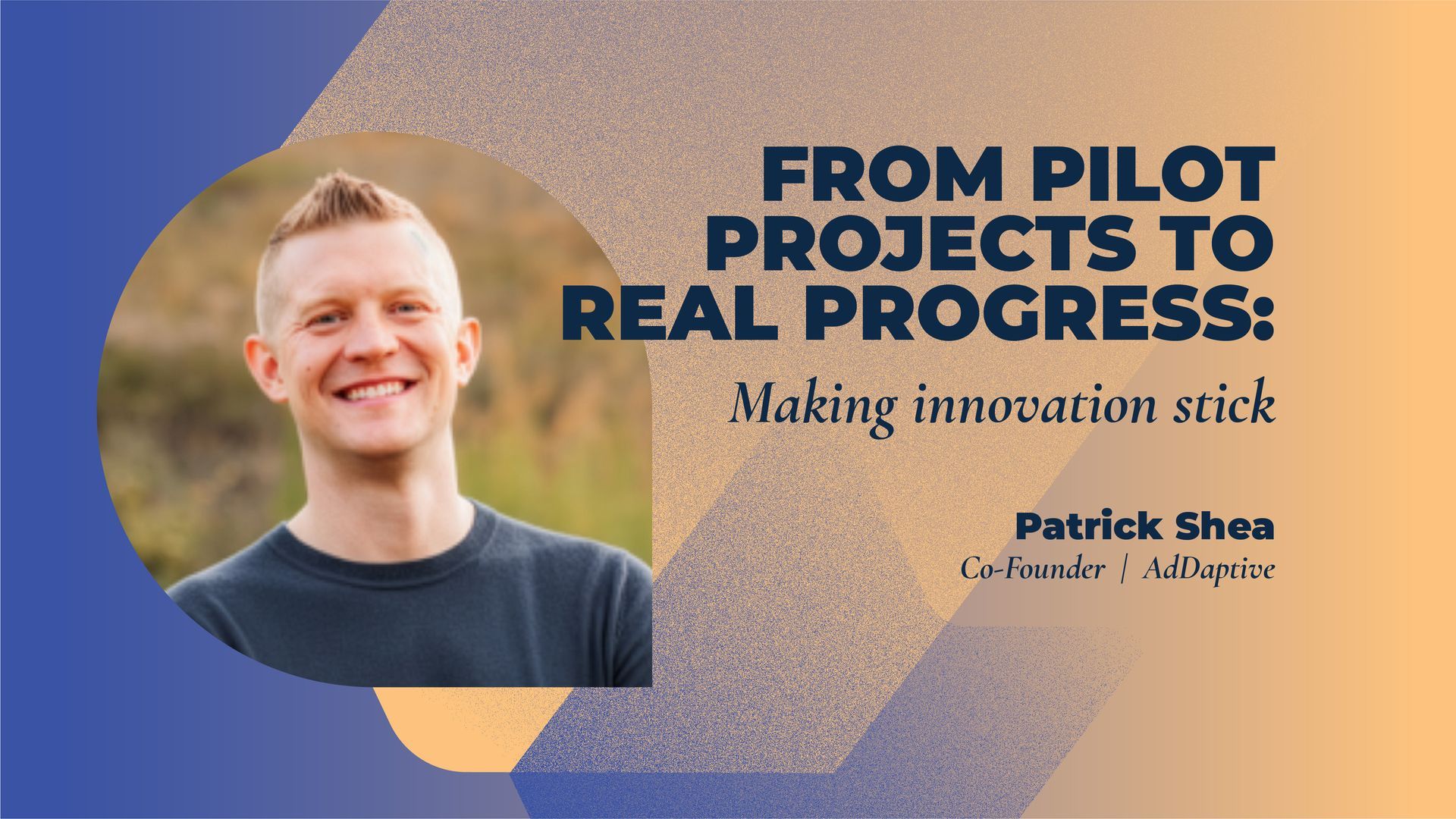
Patrick Shea
Co-founder at AdDaptive
Patrick Shea has been instrumental in shaping AdDaptive into a forward-thinking, agile company that thrives in an ever-evolving industry. Since its inception, he has focused on building a company that not only adapts to shifts in technology and market demand but anticipates them. His strategic leadership has enabled AdDaptive to stay ahead of industry trends, delivering innovative solutions that meet the needs of brands, agencies and publishers navigating the complexities of modern advertising.
Patrick is passionate about fostering a company culture that prioritizes both performance and professional growth. He takes pride in the development of AdDaptive’s proprietary technology, which has evolved into a dynamic, data-driven platform that reflects the expertise, creativity and dedication of the entire team. His leadership philosophy centers on empowering employees, setting ambitious goals and ensuring collaboration remains at the heart of AdDaptive’s success.
As AdDaptive marks its 15th year, Patrick and co-founder Kevin O’Malley remain committed to driving the company’s growth while shaping the future of ad tech. Their shared vision ensures that AdDaptive is not only prepared for the industry’s next evolution but is actively defining it.