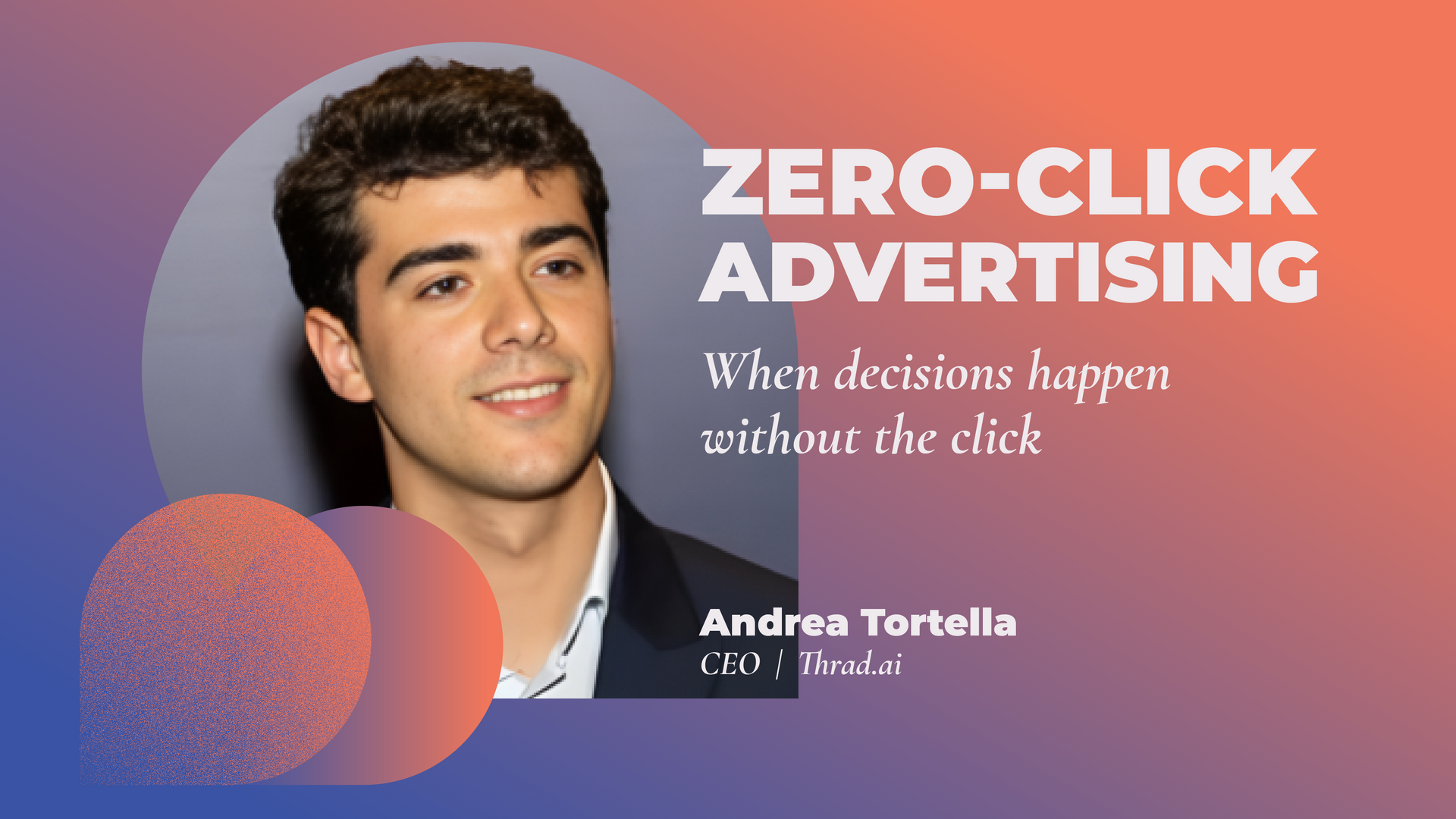
Zero-click advertising: when decisions happen without the click
In the early days of digital advertising, the click ruled everything, but that era is disappearing fast. Thrad.ai's CEO Andrea Tortella explores zero-click advertising what replaces the click, what it means to be “legible to machines,” and the power dynamics that emerge when AI becomes the decision maker.
For most of digital advertising’s history, the click was our north star. A user saw an ad, clicked through to a landing page, and we optimised everything around that journey: bids, creative, attribution, even how we designed the web itself.
In the emerging “zero-click” era, that chain is breaking. People are still discovering products and making decisions – but they’re doing it inside AI summaries, chat interfaces and agents that act on their behalf. The ad, the research, and the decision all increasingly happen in one compressed surface, with no explicit visit to a brand’s website in between.
That’s what I mean by zero-click advertising: outcomes without the traditional detour through a page view.
From pages to decision surfaces
In my work building LLM-native ad experiences, I see the same pattern everywhere: the page is no longer the atomic unit of the internet. The “surface” where decisions get made is now a model-mediated environment – a chat thread, an AI assistant, a product-finding agent.
Ask for “running shoes that won’t wreck my knees”, and you might get:
- A conversational explanation
- A curated short-list of products
- A one-tap way to buy
All inside the same interface. The ad, if it exists at all, is more likely to appear as a contextual suggestion or a ranked recommendation than as a banner. The user doesn’t “click out”; they just move from intent to outcome.
For advertisers, that changes three assumptions we’ve relied on for 20 years:
- Targeting – from keywords and audiences to understanding intents expressed in natural language.
- Measurement – from clicks and last-touch conversion to “assist” and influence inside model-driven journeys.
- Real estate – from pages we own to decision surfaces we participate in.
What replaces the click?
If clicks are no longer the main observable signal, we need new primitives for understanding effectiveness. In a zero-click environment, the key questions become:
- Did the model consider you? (Were you in the candidate set?)
- Did the user engage with your suggestion? (Hovered, expanded, saved, asked
- a follow-up, compared you.)
- Did a downstream action happen? (Purchase, sign-up, store visit, or even a
- softer outcome like adding to a shortlist.)
Some of these signals are inherently probabilistic. We won’t always be able to see every step of the chain – and honestly, that’s not new. View-through conversions, multi-touch attribution and walled gardens have already forced us to live with incomplete visibility. The difference now is that the “middle” of the journey is inside a model we don’t fully control.
The practical response is twofold:
- Double down on first-party outcomes. You still need clean, trusted signals at the edge: purchases, subscriptions, in-product events. That’s how you close the loop.
- Get comfortable with assist-based measurement. Not every valuable interaction will be a click; some will be a nudge, a ranking boost, a suggestion the user saw but didn’t immediately act on.
Zero-click advertising won’t give us perfect attribution. But it can give us richer intent signals, if we design for them.
Being legible to machines
One uncomfortable truth of this era is that the most important “user” of your content might be an AI system that never sleeps.
That means your brand has to be legible to models as well as to humans:
- Structured, up-to-date data. Product feeds, pricing, availability, reviews, policies – all in machine-readable formats that models can query and trust.
- Clear, consistent positioning. If your value proposition is muddled for humans, it will be almost incoherent for models. Ambiguity becomes invisibility.
- Evidence over hype. Models are trained to favour information that looks grounded: real benchmarks, transparent methodologies, credible sources.
This isn’t about “gaming” AI engines. It’s closer to brand building for a world where your reputation is partially encoded in parametric memory.
Creative for conversations, not feeds
The formats themselves will change. Interruptive rectangles pasted onto content never made sense inside a natural conversation – and users will have even less patience for that in chat or agentic environments.
Good zero-click advertising will feel much closer to:
- A relevant suggestion in response to an expressed need
- A side-by-side comparison card the user asked for
- A tool or workflow step that removes friction (“draft this”, “configure that”, “simulate this scenario”)
In other words, creative becomes helpfulness plus disclosure. Your best performing “ad” may look like a tiny piece of product design living inside someone else’s interface.
The uncomfortable questions
Zero-click advertising also raises real risks. If a small number of models mediate most decisions, bias and concentration of power become systemic issues, not edge cases. Who gets to appear in those suggestion slots? Whose products are never surfaced at all?
We need:
- Clear standards for disclosure when a suggestion is paid or commercially influenced
- Guardrails against abusive optimisation (for example, exploiting vulnerable intents at the moment of decision)
- Industry-wide conversations about fair access for smaller brands, not just whoever can pay the most to be “in the loop”
These aren’t philosophical side notes; they will shape user trust. And trust is the only durable asset in a zero-click world. If people feel the assistant is “selling them out”, they’ll switch it off or go elsewhere.
Where this leaves us
I don’t see zero-click advertising as the end of our industry. I see it as a compression of the funnel. The research, the comparison, the reassurance and the conversion are collapsing into a single, model-mediated moment.
Our job as advertisers, publishers, and builders is to design for that moment:
- Make our brands legible to machines
- Make our offers genuinely useful in context
- Measure influence honestly, even when the path is opaque
Clicks taught us how to optimise for attention. Zero-click will force us to optimise for relevance. And that might be the healthiest reset we’ve had in years.

Andrea Tortella
CEO, Thrad.ai
Andrea Tortella is the co-founder and CEO of Thrad, an AI ad network built for the
zero-click era. He works with AI-native apps, publishers and marketers to design
ad experiences that feel native to chats, agents and copilots rather than bolted on
from legacy channels. Andrea brings a unique perspective on how conversational
AI is reshaping the future of advertising, and has been featured by outlets such as
the WEF and CNBC for his insights on AI-driven marketing.
Thrad is the AI ad network serving native, contextual suggestions inside LLMs,
chatbots and AI agents. It helps AI products generate revenue without
compromising trust, and gives advertisers a way to reach customers at the exact
moment of intent in zero-click journeys. Learn more at: